

TL;DR:
- Blockchain tickets are cryptographically unique, immutable, and easy to verify in real time.
- Smart contracts automate resale rules and enforce compliance without human intervention.
- Zero-knowledge proofs enhance privacy by verifying access without revealing personal data.
Digital tickets feel secure. A QR code on your phone, a confirmation email, an order number — it all looks official. But appearances can deceive. Ticket fraud is a massive, ongoing problem in the live events industry, costing fans and organizers billions every year. The real issue is not whether a ticket looks valid. It’s whether you can prove it is, instantly and without ambiguity. Blockchain-based ticketing systems are fundamentally changing how trust works at event gates, shifting verification away from visual inspection and human judgment toward mathematical certainty. This article explores the mechanisms, real-world applications, limitations, and practical steps that make blockchain ticketing the most credible solution for secure event access today.
| Point | Details |
|---|---|
| Trust is essential | Event access depends on trustworthy systems to keep fraud and confusion out of the experience for guests and organizers. |
| Blockchain enables security | Blockchain technology uses transparency, cryptographic records, and automation to protect both tickets and access workflows. |
| Smart contracts automate control | Rules for resale, identity binding, and access are reliably enforced by programmable smart contracts, reducing human error. |
| ZK-proofs add privacy | Zero-knowledge proofs confirm attendee rights without exposing their data, boosting trust at scale. |
| Real-world tamper resistance | Peer-reviewed tests show these systems increasingly catch and reject fake tickets, enhancing practical trust in digital access. |
When someone hands over money for a concert ticket, they’re making a trust decision. They trust the seller, the platform, and the QR code will all align when it matters most: at the gate. That trust chain is surprisingly fragile.
Traditional digital ticketing platforms hold ticket records in centralized databases. These systems are vulnerable to data breaches, insider manipulation, and sophisticated fraud schemes. Bots sweep up large ticket inventories within seconds of release. Scalpers resell those tickets on secondary markets at inflated prices, sometimes through fraudulent storefronts. Counterfeit tickets, which look pixel-perfect to any staff member, routinely pass initial screening and only fail at the final scanner.
Here’s what makes this particularly damaging:
Efforts to reduce ticket fraud through reducing concert ticket fraud have shown that platform design directly impacts how often fraud occurs. The gap is systemic, not accidental.
“Trust in digital ticketing isn’t only about authenticating the ticket; it also depends on how resale/transfer rules are enforced and on operational factors at gates such as verification latency and scanner reliability.” Web3 and Smart Ticketing in 2026
This insight reframes the problem. Trust is not a single moment of scanning a QR code. It’s an entire system encompassing issuance, transfer, resale, and gate validation. Organizers who adopt event fraud reduction strategies that address all these layers are the ones actually protecting their events and their fans.
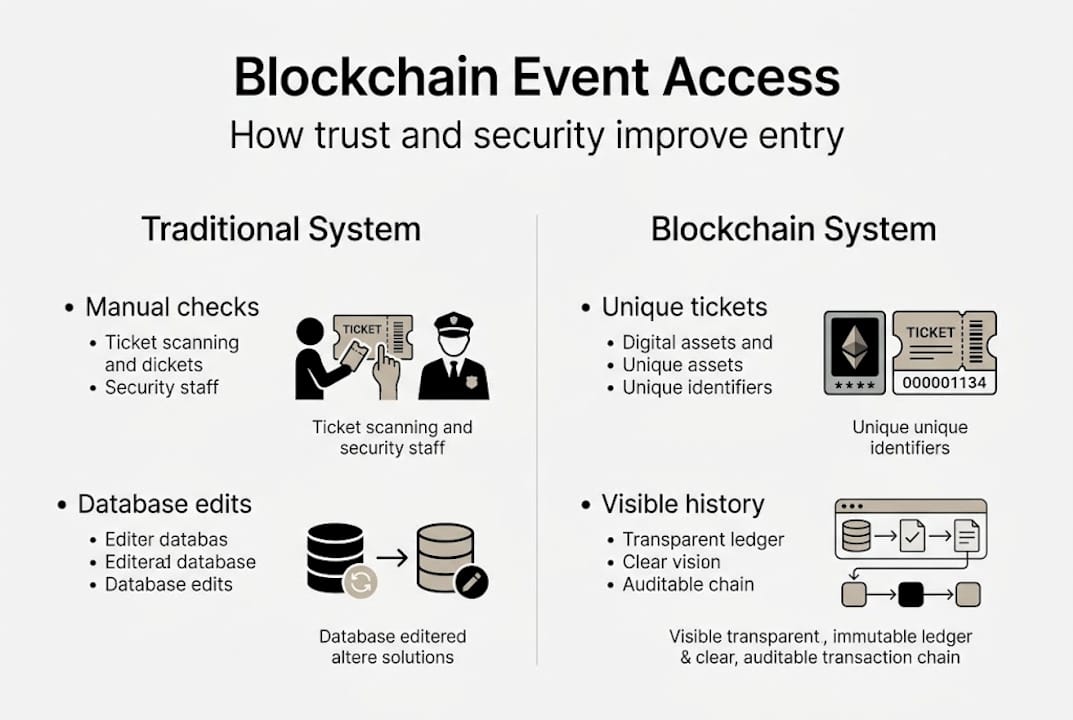
Blockchain replaces institutional trust with mathematical trust. Instead of relying on a platform’s internal database (which can be hacked, manipulated, or simply wrong), blockchain records each ticket as a unique cryptographic token on a distributed ledger. Every node on the network holds a copy. Changing one record without changing all others simultaneously is computationally impossible.
Here’s how that changes the game at event gates:
Cryptographic uniqueness means every ticket is a one-of-one entry. Duplicating it is not just difficult; it’s mathematically detectable. The moment a counterfeit is presented, verification software identifies the mismatch.
Immutability ensures that once a ticket is issued, its history is permanent and visible. You can trace it from the moment it was minted to its current owner, including every transfer in between.

Real-time auditability means organizers and third-party auditors can verify the status of any ticket at any moment without contacting a central authority. As blockchain trust research confirms, this transparency is what enables genuine accountability.
Blockchain ticketing platforms built on these principles offer a fundamentally different security model than legacy systems. The virtual ticket benefits extend beyond convenience to include provable ownership and fraud immunity.
As researchers explain, blockchain-based ticketing records tickets as “unique identifiers on a tamper-resistant ledger, enabling real-time verification and auditability of ticket transfers and redemptions.”
| Feature | Traditional digital ticketing | Blockchain-based event access |
|---|---|---|
| Ticket uniqueness | Database record (mutable) | Cryptographic token (immutable) |
| Fraud detection | Manual review, limited | Automated, real-time |
| Transfer audit trail | Partial or none | Complete and transparent |
| Resale control | Platform-dependent | Smart-contract enforced |
| Gate verification speed | Variable | Near-instant on-chain check |
Pro Tip: At your next event, ask the ticketing provider if verification happens on-chain or just against a centralized database. On-chain verification eliminates single points of failure and dramatically reduces human error at entry gates.
Once a ticket lives on a blockchain, the next layer of trust comes from smart contracts. These are self-executing programs coded directly into the blockchain that automatically enforce rules without needing a human administrator.
Here’s how they work in practice for event access:
Academic research on blockchain in sports and event management frames this clearly: trust arises from transparent and immutable tracking, with smart contracts making compliance auditable and fraud mitigation systematic.
| Smart contract rule | What it prevents | Benefit to organizers |
|---|---|---|
| Supply cap enforcement | Overselling | Revenue accuracy |
| Resale price ceiling | Scalping | Fan goodwill |
| Identity binding | Fraudulent transfers | Reduced chargebacks |
| Single-use redemption | Double entry | Capacity integrity |
| Transfer whitelist | Unauthorized resale | Brand protection |
A security evaluation of smart-contract ticketing systems confirms these rules hold up under adversarial conditions. The automation removes subjectivity from compliance entirely. An organizer using blockchain fraud reduction tools does not need to trust staff to enforce resale rules manually because the contract does it automatically, every time.
For fans who want to buy event tickets with crypto, smart contracts also provide payment transparency. Every transaction is auditable, meaning you can verify exactly what you paid and when ownership changed hands.
Smart contracts verify what a ticket is. Zero-knowledge proofs (ZK-proofs) verify who can use it — without exposing any personal information in the process.
In plain terms: a ZK-proof lets you prove a statement is true without revealing the underlying data. In ticketing, this means a fan can prove they hold a valid ticket without broadcasting their wallet address, purchase history, or identity to anyone at the gate.
Why does this matter? Traditional verification systems collect personal data at every touchpoint. Staff check IDs, platforms store purchase records, and scanners log entry times. Each data point is a potential vulnerability. ZK-proofs remove most of that exposure.
Key benefits of ZK-proof-based access:
This is a genuine leap forward. Current ticket verification at major concerts relies on staff judgment and centralized databases. Both fail regularly. ZK-proofs take human error and central authority out of the equation entirely.
Pro Tip: If you’re an event organizer evaluating blockchain platforms, ask specifically about ZK-proof integration at entry points. It signals that the platform takes both security and attendee privacy seriously, which matters for compliance with data privacy regulations.
For events like real-time verified experiences, where rapid entry and VIP access management are critical, ZK-proofs enable seamless flow without sacrificing security.
Theory becomes value only when applied. Here’s how both sides of the event equation can put blockchain-based trust into action.
For event organizers:
For ticket buyers:
The numbers reinforce why this matters. A peer-reviewed security test of a blockchain e-ticket distribution system injected 10% counterfeit tickets into the system. Every single one was detected and rejected. That’s tamper-resistance at a level no traditional platform comes close to matching.
Reviewing event ticketing best practices confirms that seamless, secure entry experiences depend on preparation from both organizers and attendees. When both sides operate with verified, on-chain tickets, fraud has nowhere to hide.
We believe blockchain and smart contracts are the most powerful trust infrastructure the event industry has ever had. But we’ve also seen what happens when technology is deployed without operational discipline.
Scanners go offline. Staff skip verification steps under crowd pressure. Fans don’t understand how to use crypto wallets. Organizers deploy smart contracts without auditing them. These are not hypothetical failures; they happen regularly.
Sustainable trust requires more than a new platform. It requires ongoing fraud reduction perspective applied at every stage: smart issuance, clear user education, reliable hardware, and consistent policy enforcement. Blockchain raises the ceiling on what’s possible. Getting there takes commitment from organizers, platforms, and fans together.
The technology is ready. The industry’s operational habits need to catch up. That’s the real work ahead.
If the trust mechanisms covered in this article resonate with you, Backstage.global is built to put them into practice. Our blockchain event ticketing platform issues every ticket as a verified, on-chain token, stored securely in your mobile wallet and validated via QR code at the gate.
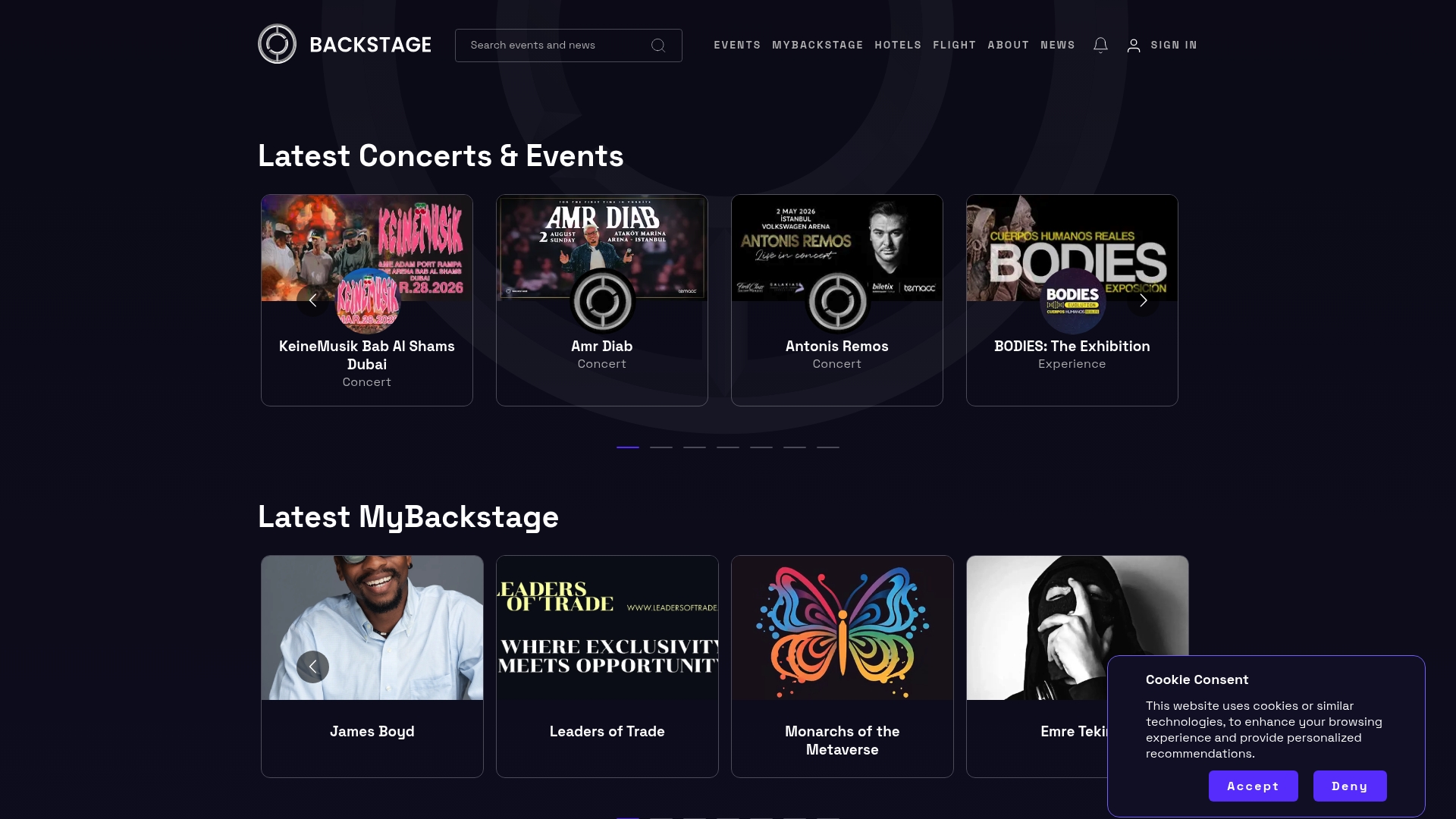
We support crypto and credit card purchases, enforce smart-contract resale rules, and provide real-time verification that eliminates counterfeit tickets before they become a problem. Whether you’re an organizer protecting your event or a fan protecting your purchase, Backstage.global gives you the trust infrastructure that legacy platforms simply can’t match. Explore the platform today and experience what secure, transparent ticketing actually feels like.
Blockchain secures tickets as unique, immutable entries on a tamper-resistant ledger, making duplication and unauthorized resale nearly impossible while enabling instant, auditable verification at event gates.
Zero-knowledge proofs let a system verify a ticket-holder’s right to enter without revealing personal data. This approach verifies claims mathematically against on-chain state, enabling rapid, privacy-preserving access without relying on human judgment.
Yes. Smart contracts automate compliance and make audits transparent, letting organizers enforce access, transfer, and resale rules in real time without manual intervention.
Peer-reviewed tests show blockchain systems detect and reject up to 10% of deliberately counterfeited tickets in simulated scenarios, demonstrating strong tamper-resistance that traditional platforms cannot replicate.
 News
AFTERWAVE Ibiza 2026: Mr Afterparty Launches a New Wednesday Boat Party Experience A new wave is arriving in Ibiza. Mr Afterparty presents AFTERWAVE , a new Wed…
Read more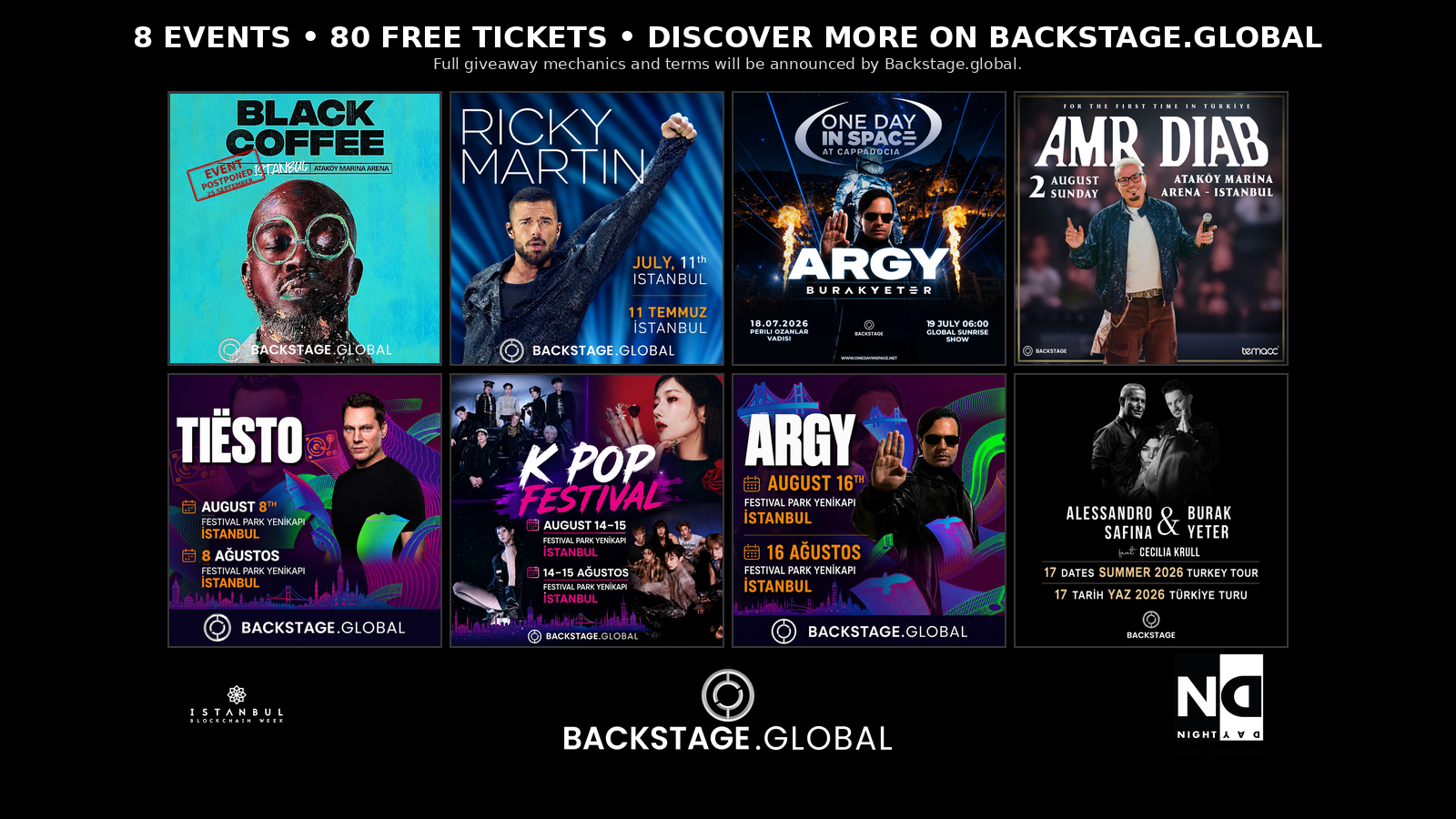 News
Win Free Tickets to Backstage.global Events in Turkey An Exclusive Promotion During Istanbul Blockchain Week 2026 Backstage.global x IBW2026 – Exclusive Ticket…
Read more News
We are proud to announce that Backstage.global is the Official Web3 Entertainment Partner of Istanbul Blockchain Week 2026 — the premier Web3 conference and exp…
Read more